
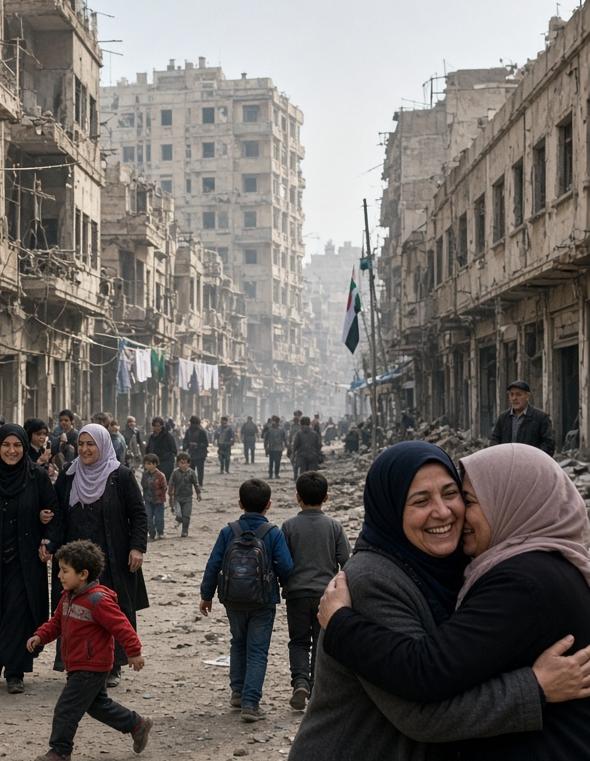
The fall of Bashar al-Assad has created an opening for Syria’s long-awaited political transformation. But the humanitarian consequences of the transition will depend on whether political change can be converted into security, services and sustainable conditions for return.
The collapse of Bashar al-Assad’s government in December 2024 fundamentally altered Syria’s geopolitical landscape. After more than a decade of war, millions of Syrians suddenly found themselves facing a new question: not whether to survive displacement, but whether it was finally possible to return home.
The initial response was characterised by both optimism and caution.
By April 2025, UNHCR estimated that around 400,000 Syrian refugees had returned from neighbouring countries since the fall of the Assad government, while more than one million internally displaced Syrians had also returned to their areas of origin or preferred destinations.
These numbers are politically significant.
They suggest that the end of the Assad era has changed the psychology of displacement. For many Syrians, return is no longer an abstract possibility. It has become an active choice.
But return is not the same as recovery.
The danger of confusing political transition with humanitarian normalisation
Syria entered the transition with enormous structural damage.
Years of conflict had destroyed housing, hospitals, schools, electricity networks and water infrastructure. The economy had contracted dramatically, while poverty and unemployment had become entrenched.
UNHCR continued to describe Syria as one of the world’s most complex humanitarian crises, with millions of people still displaced internally and across international borders.
This creates a fundamental challenge for the transitional authorities and international community.
A refugee may be willing to return because the political regime has changed. But remaining in Syria requires considerably more: security, housing, documentation, healthcare, education and access to livelihoods.
If these conditions do not exist, return can become a new form of vulnerability.
The regional dimension
Syria’s humanitarian crisis has never been confined to Syrian territory.
Türkiye, Lebanon, Jordan and Iraq have hosted millions of Syrian refugees for years. The economic and political costs of prolonged displacement have increasingly affected host societies.
This makes the Syrian transition a regional humanitarian issue.
For neighbouring governments, successful Syrian stabilisation could reduce long-term refugee pressures. For European governments, it could eventually influence migration dynamics. For humanitarian organisations, it creates a difficult balancing act between supporting returnees and continuing assistance to Syrians who remain displaced or who are not yet able to return.
The key principle should therefore be voluntariness.
International agencies have repeatedly emphasised that returns must be voluntary, informed and safe rather than driven by economic pressure or political coercion.
This distinction will become increasingly important as funding for the regional refugee response remains under pressure.
Reconstruction is a geopolitical question
Syria’s reconstruction cannot be separated from international politics.
Western sanctions, relations with the transitional authorities, the role of Türkiye, Gulf states, Iran, Israel and Russia, and the question of Syria’s reintegration into the regional economy will all influence the country’s ability to recover.
The humanitarian dimension is particularly important because sanctions and economic restrictions can have effects far beyond the political actors they are designed to influence.
At the same time, lifting or easing restrictions without political safeguards raises another concern: whether economic recovery will benefit the population broadly or reinforce new concentrations of political and economic power.
The international community therefore faces a difficult equilibrium.
Syria needs economic recovery, but recovery without institutional reform may reproduce some of the vulnerabilities that contributed to the previous crisis.
The return question
The most visible humanitarian indicator of Syria’s transition may be the number of people returning.
But the more meaningful indicator will be whether those people remain.
In April 2025, UNHCR was already warning that needs were intensifying as hundreds of thousands returned.
This highlights an important distinction between repatriation and reintegration.
A family can cross the border in a single day. Rebuilding a functioning life can take years.
A damaged house may need reconstruction. Property documents may be missing. Schools may be destroyed. Healthcare may be inaccessible. Employment may not exist.
For internally displaced Syrians, the same challenges exist on a different scale.
Humanitarian aid cannot carry the entire transition
The international response must therefore evolve.
During the war, humanitarian organisations focused primarily on emergency assistance: food, shelter, medical care and protection.
During the transition, those activities remain necessary, but they need to be connected to early recovery.
Repairing a water network can simultaneously be humanitarian assistance and economic recovery. Restoring a school can support both protection and reintegration. Legal assistance can help returnees recover property rights and civil documentation.
This is why Syria’s transition requires a closer connection between humanitarian, development and diplomatic policy.
The traditional separation between emergency relief and reconstruction is becoming increasingly artificial.
The geopolitical stakes
A stable Syria would have consequences throughout the Middle East.
It could reduce regional displacement pressures, alter Türkiye’s security calculations, affect Lebanon’s economic and political environment and change the balance of influence among regional powers.
But instability could produce the opposite result.
A fragile transition could generate renewed displacement, deepen sectarian tensions and create space for armed groups and external actors to compete for influence.
The humanitarian stakes are therefore inseparable from the political stakes.
The central test
Syria’s post-Assad transition should not be judged simply by whether refugees return.
The real test is whether people can return and stay.
That requires security, functioning institutions, basic services, economic opportunity and guarantees against renewed persecution.
If those conditions emerge, Syria could represent one of the most consequential humanitarian transitions in the Middle East in decades.
If they do not, the international community may witness a cycle in which refugees return prematurely, encounter unmanageable conditions and become displaced once again.
The fall of Assad has therefore opened a door.
The challenge now is to make sure that the humanitarian foundations exist on the other side of it.