
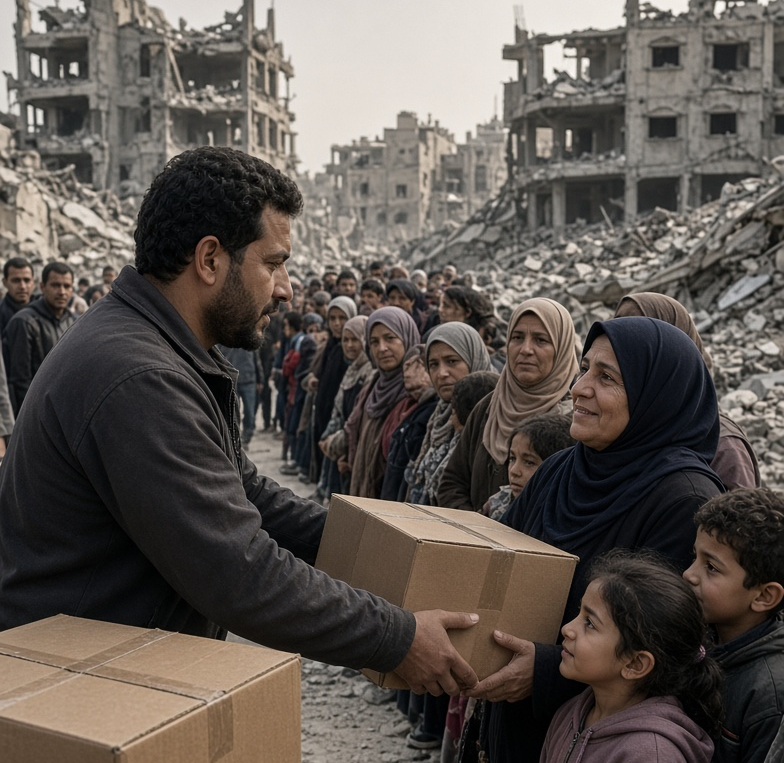
The collapse of the Gaza ceasefire has demonstrated how quickly humanitarian improvements can disappear when the political framework supporting them breaks down.
The first phase of the Gaza ceasefire, which began on 19 January 2025, created a striking humanitarian contrast with the preceding months. Humanitarian organisations were able to scale up operations, deliver food and shelter assistance and reach populations that had previously been extremely difficult to access. By mid-March, OCHA reported that humanitarian partners had been able to secure assistance for nearly everyone in Gaza during the first phase of the ceasefire.
That improvement was fragile from the beginning.
Food security remained heavily dependent on continued access to humanitarian supplies, and OCHA warned in early March that the gains achieved during the ceasefire could quickly be reversed.
On 18 March, hostilities resumed on a large scale. At the same time, humanitarian supplies remained blocked after the suspension of aid and commercial flows into Gaza on 2 March. UN humanitarian officials warned that the combination of renewed military operations and restricted access could have disastrous consequences for the civilian population.
The humanitarian lesson is clear: access is not a secondary component of a ceasefire. It is one of its most tangible consequences for civilians.
The humanitarian economy of Gaza
The Gaza crisis illustrates a fundamental feature of modern warfare: military operations can destroy not only physical infrastructure but also the systems through which civilians survive.
Food markets, water systems, electricity networks, hospitals, fuel supplies and transport routes are interconnected. When one component fails, the consequences propagate through the entire system.
This means that humanitarian access cannot be reduced to the question of whether a certain number of trucks cross a border.
A humanitarian system needs predictable access, fuel, functioning roads, communications, warehouses, medical personnel and security guarantees. Even when aid physically enters a territory, destroyed infrastructure and insecurity can prevent it from reaching the people who need it.
The temporary improvement during the January-February ceasefire therefore mattered politically as much as humanitarianly. It demonstrated that the humanitarian situation was not simply a consequence of geography or unavoidable scarcity. The level of assistance civilians received was closely connected to political decisions about access and security.
Aid as leverage
The central geopolitical controversy is whether humanitarian access can remain separate from military and political bargaining.
Israel has argued that humanitarian restrictions must be considered alongside security concerns and the threat posed by Hamas. Humanitarian organisations and UN officials, meanwhile, have repeatedly argued that civilians must have access to essential assistance regardless of political negotiations.
This tension is not unique to Gaza, but Gaza has made it particularly visible.
If humanitarian supplies become conditional on progress in negotiations, aid risks becoming part of the bargaining mechanism itself. That creates an ethical and operational problem: civilians may effectively become dependent on political developments over which they have no control.
The principle of humanitarian action is different. Food, medicine, water and emergency healthcare are supposed to be provided according to need rather than political allegiance.
That distinction becomes particularly important in a densely populated territory where displacement has repeatedly forced civilians into new areas.
Health is where the crisis becomes irreversible
The consequences of restricted humanitarian access are especially severe in healthcare.
Hospitals do not function independently of the wider humanitarian system. They require electricity, fuel, water, medicines, surgical equipment, food and functioning roads.
WHO warned in May that the entire population of Gaza was experiencing prolonged food shortages and that nearly half a million people were already facing catastrophic levels of hunger, acute malnutrition and related health risks.
The danger is cumulative.
Malnutrition weakens immune systems. Poor sanitation increases disease transmission. Disrupted healthcare delays treatment. Fuel shortages affect hospitals and water systems. Displacement makes chronic disease management more difficult.
A humanitarian crisis therefore moves from emergency to structural collapse when these systems begin reinforcing one another.
The geopolitical implications
The Gaza crisis is also testing the credibility of the international humanitarian system.
If international organisations cannot secure reliable access to civilians during active conflict, their capacity to operate becomes dependent on the political calculations of the parties controlling territory and borders.
That has consequences beyond Gaza.
The same question arises in Sudan, Syria, Ukraine, Myanmar and other conflicts: who ultimately determines whether humanitarian principles can be implemented?
The answer increasingly appears to be a combination of military control, diplomatic pressure and international political will.
This makes humanitarian diplomacy inseparable from geopolitics.
What should come next?
The immediate priority is straightforward: humanitarian access must be restored and maintained independently of the broader political timetable.
But the longer-term question is more difficult.
Gaza will require not only emergency relief but reconstruction of hospitals, water systems, housing, schools and public institutions. That cannot happen without a political framework capable of providing security and predictable access.
The experience of early 2025 therefore offers a broader lesson: ceasefires are humanitarian instruments as much as political agreements.
The period between January and early March demonstrated what can happen when access improves. The return to hostilities demonstrated how quickly those gains can disappear.
For civilians, geopolitics is ultimately experienced through very practical questions: Is there food? Is there clean water? Can an ambulance move? Is a hospital functioning? Can a family remain safely in one place?
These are not peripheral questions to the conflict.
They are among its most important geopolitical consequences.