
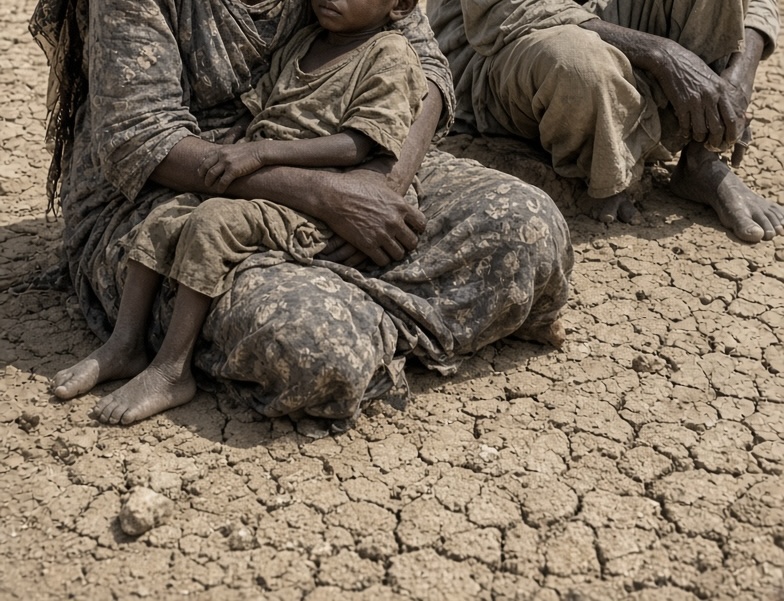
Sudan’s humanitarian catastrophe is increasingly becoming a test of whether the international system can protect civilians when political interests, military calculations and access to aid collide.
Sudan entered 2025 facing one of the world’s most severe humanitarian emergencies. More than 30 million people — over half of the country’s population — were expected to require humanitarian assistance during the year. At the same time, the food-security crisis was expanding dramatically: the Integrated Food Security Phase Classification estimated that 24.6 million people were experiencing acute food insecurity, while famine had already been detected in several areas and was projected to expand further.
The numbers are extraordinary, but the central geopolitical question is not simply how much aid Sudan needs. It is whether humanitarian assistance can be delivered independently of the military and political geography of the war.
The conflict between the Sudanese Armed Forces and the Rapid Support Forces has fragmented the country into competing zones of control. This has transformed humanitarian access from a logistical problem into a political one. Roads, border crossings, airports and local administrative structures are no longer merely pieces of infrastructure; they are instruments through which armed actors can influence civilian survival.
The humanitarian consequences are particularly severe in Darfur and the Kordofan regions. The IPC assessment identified famine in five areas and projected further expansion between December 2024 and May 2025. The crisis has been driven not only by the destruction of food supplies, but also by displacement, the collapse of public services, economic disruption and restricted humanitarian access.
This is where Sudan’s humanitarian crisis becomes a geopolitical problem.
Geography is becoming a weapon
Sudan’s neighbours are being pulled into the consequences of the war. Millions of people have been displaced internally or have crossed international borders. By February 2025, UNHCR described approximately 12 million people as displaced inside Sudan and across the region.
Chad, Egypt, South Sudan, Ethiopia and the Central African Republic are therefore not simply observers of Sudan’s conflict. They are absorbing its humanitarian consequences.
For neighbouring states, refugee flows create immediate pressure on food systems, public services and border communities. For international organisations, the same geography determines where assistance can enter and which populations can realistically be reached.
The result is an uncomfortable paradox: the areas with the greatest humanitarian needs are often the areas where humanitarian organisations face the greatest access constraints.
This is one reason famine cannot be treated simply as a food-distribution problem. Food may exist elsewhere in Sudan or in neighbouring countries, yet populations can still starve if conflict prevents them from reaching markets, fields, humanitarian distribution points or safe transport corridors.
The international response is caught between diplomacy and necessity
The international community has repeatedly called for humanitarian access and civilian protection. But humanitarian diplomacy faces a fundamental limitation: aid agencies cannot negotiate away the military incentives of armed actors.
For the Sudanese parties, controlling territory means controlling economic resources, population movements and, in some areas, access to humanitarian assistance. This creates an environment in which humanitarian neutrality can become difficult to maintain.
The international community therefore faces a choice between treating humanitarian assistance as an emergency service and recognising it as part of the wider political architecture of the conflict.
A purely technical response — more food, more medical supplies, more funding — is indispensable but insufficient.
The IPC itself has stressed that preventing famine requires an end to active hostilities, restoration of safe humanitarian access and immediate assistance to populations already facing famine or at risk of entering it.
In other words, humanitarian relief cannot substitute for political action.
Sudan’s wider strategic significance
Sudan’s location gives the crisis implications well beyond its borders. It sits between North Africa, the Red Sea, the Sahel and the Horn of Africa. Instability therefore intersects with migration routes, maritime security, regional competition and the interests of external powers.
But the greatest geopolitical danger may be less spectacular: prolonged humanitarian collapse can gradually change the social and economic structure of a state.
When families lose access to land, markets, schools and health services, displacement becomes more permanent. When children experience prolonged malnutrition or lose years of education, the consequences extend well beyond the current conflict.
A humanitarian emergency can therefore become a mechanism for producing long-term political fragmentation.
The central question for 2025
Sudan’s crisis should not be judged solely by the amount of money pledged by donors or the number of humanitarian convoys that reach the country.
The more important test is whether civilians can regain predictable access to food, healthcare, shelter and protection regardless of which armed actor controls their neighbourhood.
That requires humanitarian diplomacy, but also sustained pressure on the parties to the conflict, regional engagement and protection of cross-border humanitarian corridors.
Sudan demonstrates a broader reality of contemporary conflict: starvation does not always result from the absence of food. It can result from the destruction of the political, economic and security systems that allow food to reach people.
The longer that reality persists, the more Sudan’s humanitarian catastrophe risks becoming a geopolitical crisis whose consequences will outlast the war itself.